Flute · treble clef
Flute Fingering Chart
Every note on the flute, from low C to the C three octaves up. Tap a note to see it larger, hear it, and find alternate fingerings.
Flute is a concert-pitch instrument: it sounds the note that is written.
First octave
Right pinky presses the low C roller; cover every hole fully and use slow, relaxed air.
Right pinky moves to the C♯ roller instead of the D♯ key.
One of the few notes with the right pinky lifted.
Use the right ring finger, not the middle finger.
Left pinky presses the G♯ key.
Use the thumb B♭ lever version only when the passage has no B natural.
The left thumb comes off.
Only the right pinky stays down; this note can sound weak, so keep the air focused.
Second octave
Like low D, but lift the left index finger.
Like low D♯, but lift the left index finger.
Uses the same fingering as low E; blow faster air.
Uses the same fingering as low F; blow faster air.
Uses the same fingering as low F♯; blow faster air.
Uses the same fingering as low G; blow faster air.
Uses the same fingering as low G♯; blow faster air.
Uses the same fingering as low A; blow faster air.
Uses the same fingering as the lower B♭; blow faster air.
Uses the same fingering as the lower B; blow faster air.
Same fingering as the C in the staff (C5); blow faster air.
Same fingering as the C♯ in the staff (C♯5); blow faster air.
Third octave
Like the D in the staff (D5), but lift the right index, middle and ring fingers and put the pinky down.
Every finger down plus the G♯ key; not the same as the lower D♯ fingerings.
Left ring finger is lifted, unlike the lower E.
Left middle finger is lifted.
Same as the lower G but with the thumb off.
Thumb and left index finger are both off.
Uses the first trill key; the right pinky lifts off the D♯ key.
Uses the second trill key; the right pinky lifts off the D♯ key.
Thumb off and right pinky up.
Printable chart
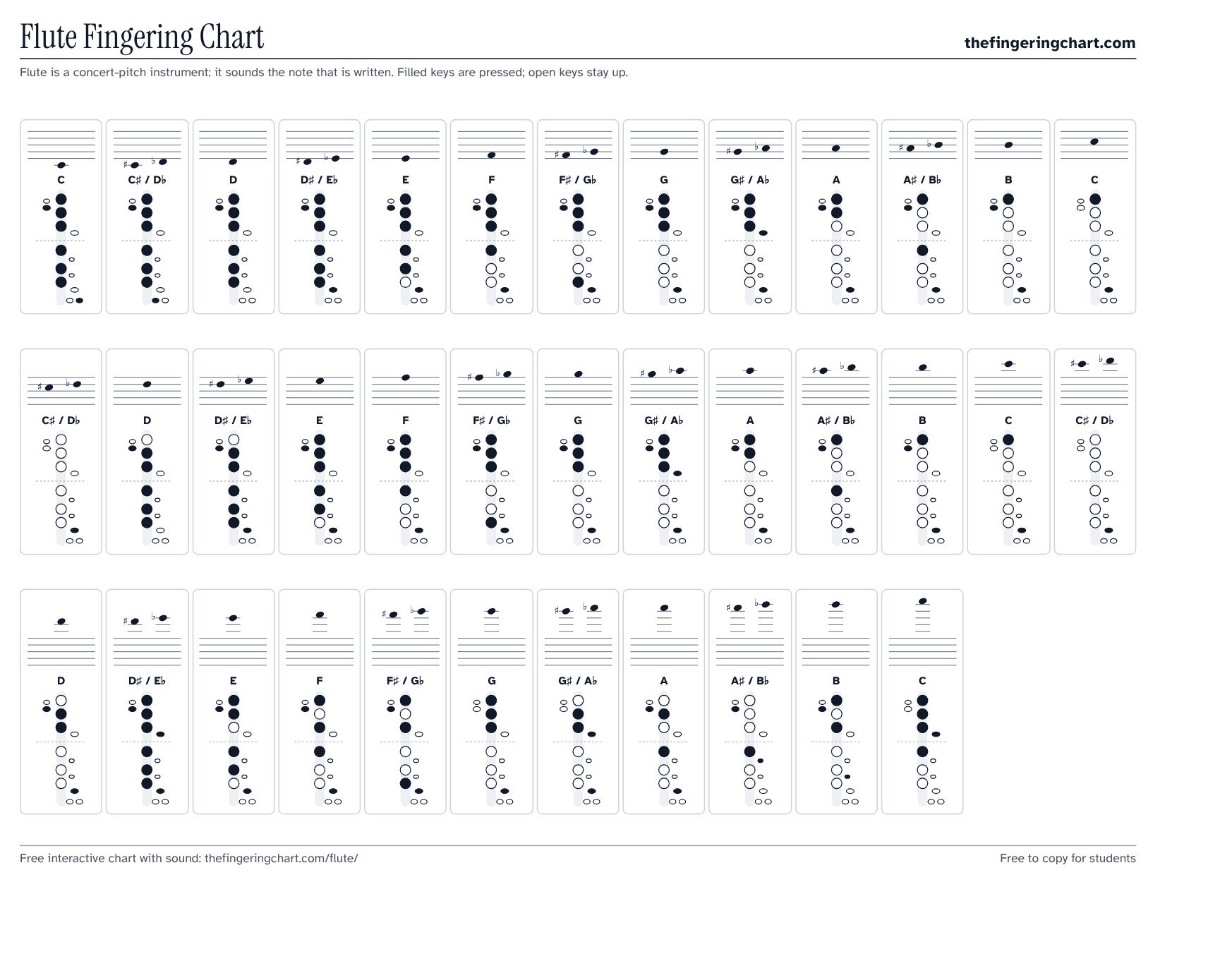
How to read this chart
Filled keys are pressed. Open ones stay up.
The two thumb keys are drawn to the left of the first finger. The dashed line separates the left hand (top) from the right hand (bottom).
The right pinky rests on the D♯ key for almost every note. The two keys at the very bottom are the foot joint rollers for low C♯ and C.
Which notes come first
Most beginners learn the first and second octaves first. The third octave needs faster, more focused air and has its own fingerings.
Next: Flute scales · Flute trill chart